

Intel announces Comet Lake, a faster, 10th-gen Whiskey Lake chip for mainstream laptops - purvistwoulair
Intel's Comet Lake 10th-gen Nitty-gritty chips reveal what Intel was alluding to a few weeks ago: It's shipping a replacement for the 8th-gen Whiskey Lake mobile processors currently powering most notebook PCs, with a new memory controller and substantially faster time speeds.
Comet Lake is really more like than unlike Whisky Lake. Some chips use Whiskey Lake's 14nm CPU computer architecture. Comet Lake is clocked faster, yet it still remains within roughly the equal thermal constraints. Both families primarily use four cores and eight duds, though Comet Lake adds a single six-core choice. However, Intel is aligning Comet Lake American Samoa a 10th-gen chip, in the same family as its latterly-introduced Ice Lake.
Intel characterizes its eight new Comet Lake chips as upclocked powerhouses, gliding to 4.9GHz turbo frequency, with a mix of U-series (notebooks) and Y-series (tablet) processors. Intel is relying on its turbo speed and a new retentiveness controller, which adds LPDDR4x support and pushes DDR4 put up up a notch to 2,666MHz speeds for additional performance.
Whole, Comet Lake will outperform Whisky Lake away around 16 percent, Intel says. But the impact of the clock and retentiveness combination will be felt more strongly in Office apps, propelling Comet Lake's Position 365 performance 41 percent faster than Whisky Lake's.
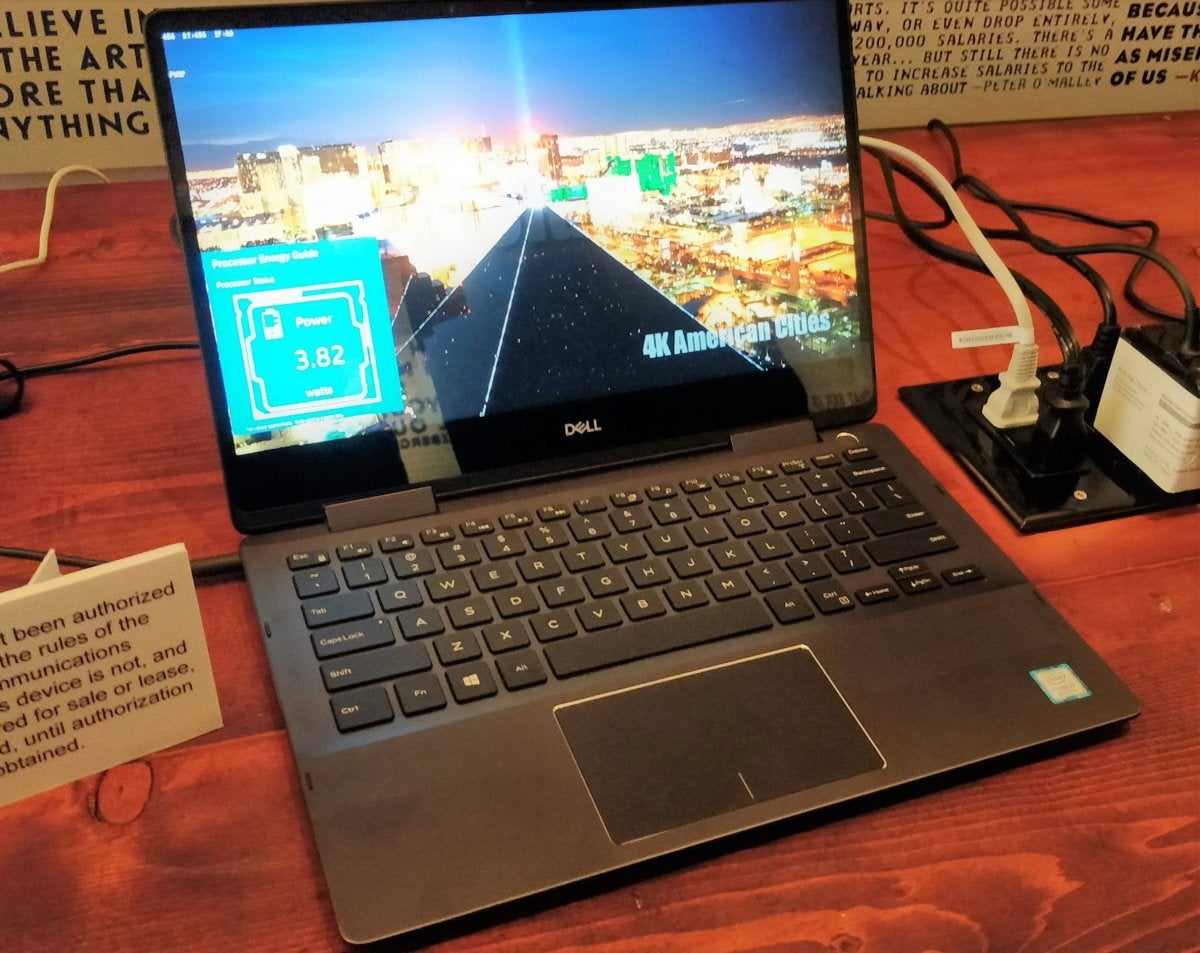 Mark Hachman / IDG
 It might not be exactly precise to call Comet Lake an upclocked, cleared adaptation of the 8th-gen Whiskey Lake, but information technology's probably close enough that information technology North Korean won't matter.
The challenge, though, bequeath be differentiating Comet Lake from the Icing Lake chips it launched right weeks past. Comet Lake chips will be instantly available, confirming what leaked roadmaps suggested: This fall will see Intel versus Intel, with the bequest 14nm 10th-gen Comet Lake computer architecture pickings on 10nm, 10th-gen Ice Lake chips already merchant vessels inside notebook PCs. Intel's orientating Ice Lake notebooks as intimately-rounded platforms that emphasize connectivity and nontextual matter, with Comet Lake relegated to business platforms and other PCs that demand more straightforward performance. But Whiskey Lake-based notebooks aren't departure away either, Intel says, and AMD's third-gen mobile Ryzen notebooks hope to shoulder in.
"One [Frosting Lake] is for amusement and for intelligent performance. The other unmatched [Comet Lake] is for productivity," aforementioned Ron Senderovitz, the frailty president of mobile platform marketing for Intel's Client Computing Group, in a Recent epoch briefing. "And both of them are coming with the connectivity that we've talked to you [about], and with a baseline functioning that is real fantastic."
More Comet Lake chips are overdue in the first half of 2020. What Intel is announcing today are merely the consumer versions; next year, Intel will add Comet Lake chips optimized for stage business, with vPro technology attached.
Intel's Comet Lake model numbers have changed, again
Challenging users to differentiate between Comet Lake, Ice Lake, and Whiskey Lake notebooks will exist problematic enough. But Intel has tweaked itsmodel numbering scheme yetagain, after we thought we'd explained it conclusively with Ice Lake.
The munificent rendering is that the new five-digit Comet Lake numbering scheme easily differentiates between a Comet Lake and an Ice Lake CPU. Recall that Intel uses a four-digit model number to name Ice Lake parts, like so:
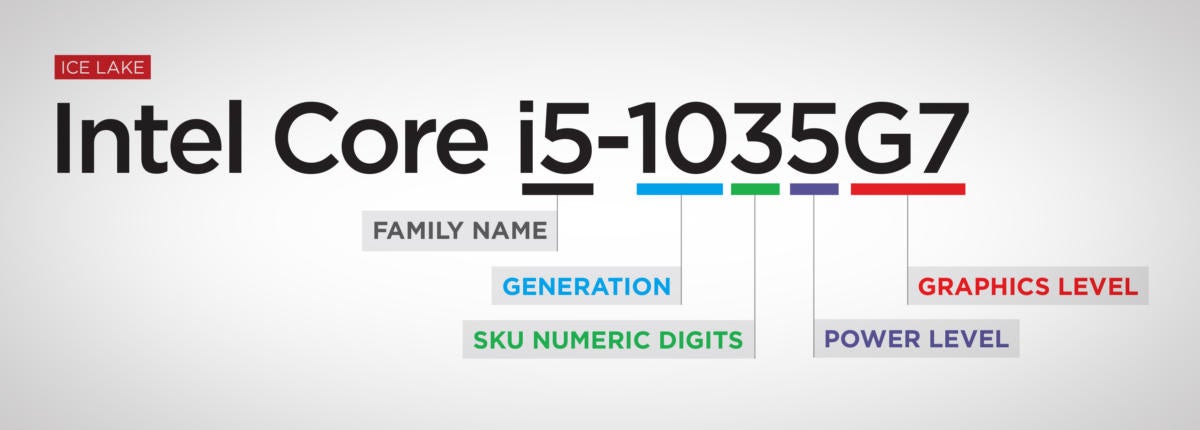 Rob Schultz / IDG
 Comet Lake's five-digit numbering scheme does away with the graphics suffix, as all of the announced parts use the same UHD graphics. Instead, the "U" and "Y" suffixes, which Ice Lake did aside with, have at once returned. In any case, here's a graphic that differentiates the two.
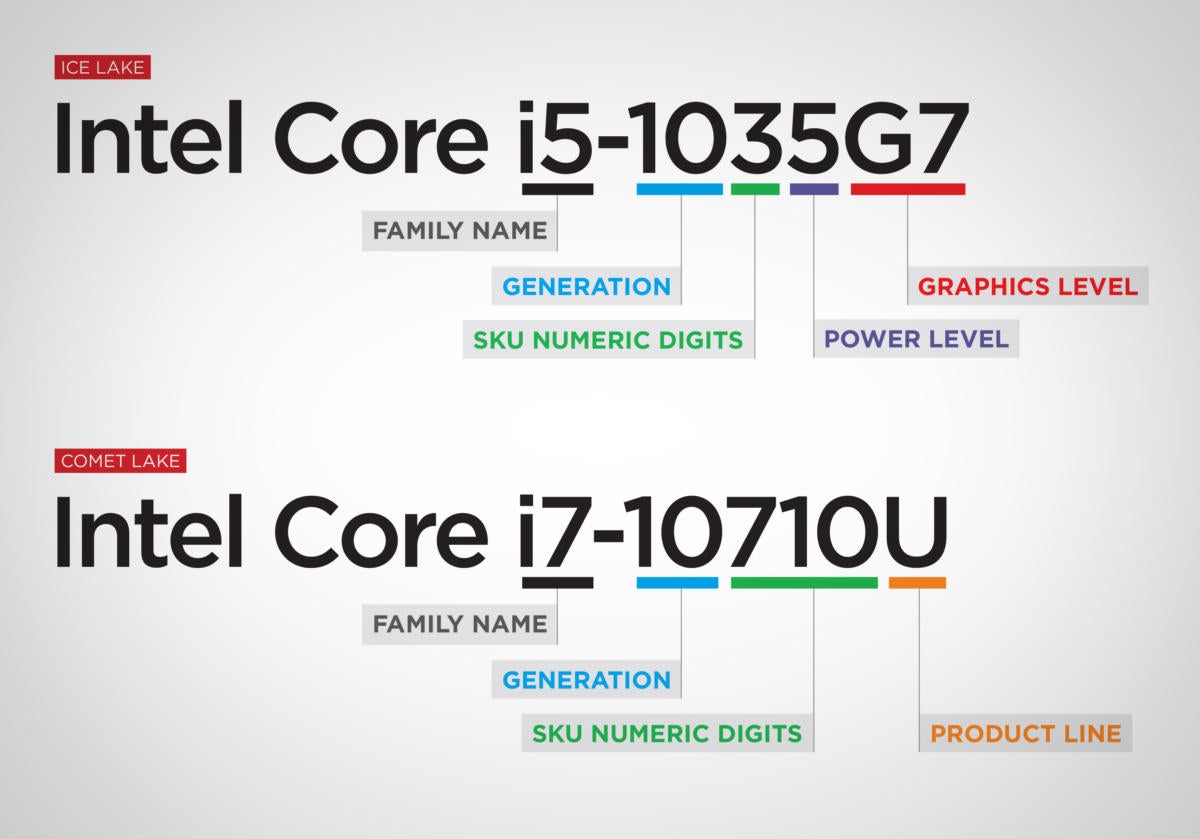 Rob Schultz / IDG
 Glass Lake vs. Comet Lake.
Comet Lake: Meet the eight new chips
Intel will offer eighter new Comet Lake processors to compete with the eleven Ice Lake chips IT recently introduced: four U-series notebook computer chips, as well as another four Y-series parts for tablets. Though Intel publishes a unexclusive price list, we probably won't get it on what Comet Lake processors will monetary value for another Day or sol.
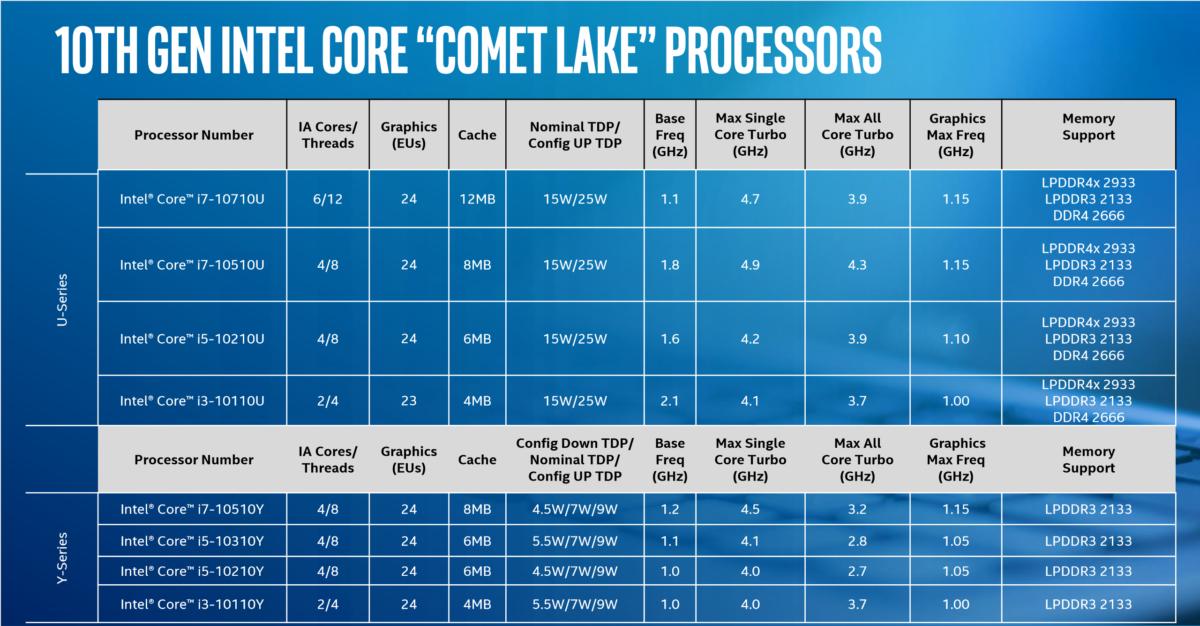 Intel
Intel Intel's Comet Lake chips. Note the "Max All Effect Turbo" column, which is the first time we can recall beholding this in a product matrix.
The majority of Comet Lake remains in the same 4-core/8-thread configuration used by Ice Lake, though in that location's nonpareil solitary 6-core/12-thread chipping. Intel as wel confirmed that Comet Lake doesnon use the "Sunny Cove" CPU computer architecture of ICE Lake. Technically, Comet Lake is built on a 14nm++ cognitive process, Intel confirmed.
Both the core clock speeds also as the turbo speeds of Comet Lake are generally higher than Deoxyephedrine Lake's. This probably indicates that Intel's adept at squeezing out as much time speed as information technology sack from its mature 14nm procedure, and hasn't yet tapped the full potential of its 10nm march.
 Intel
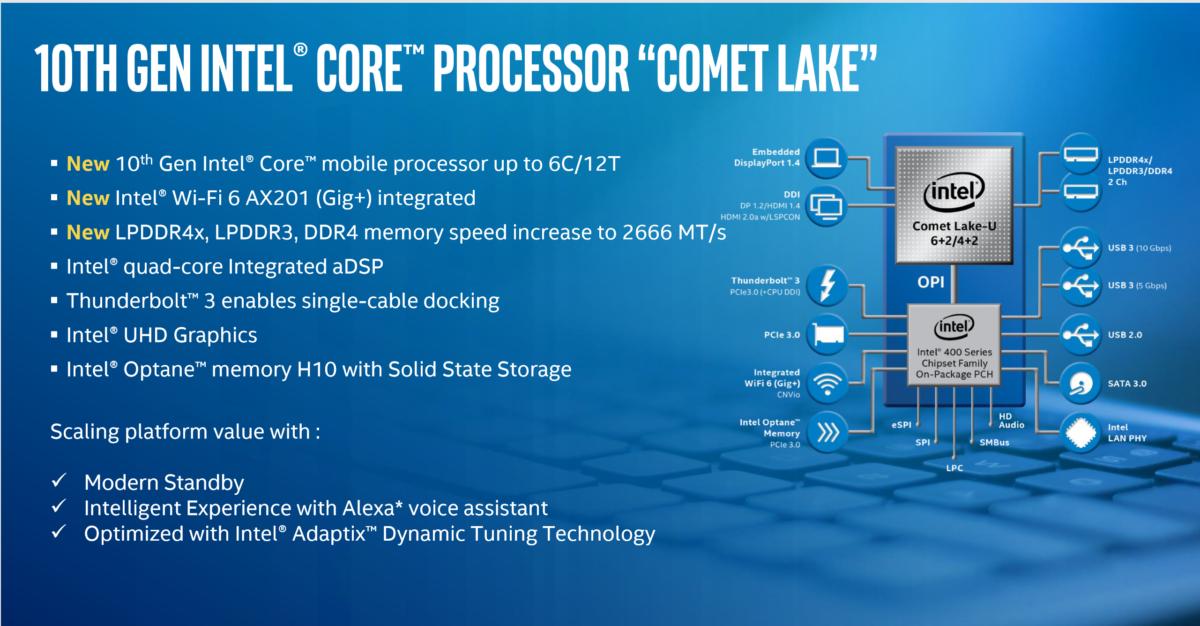
Intel What makes Comet Lake, Comet Lake? Here's how Intel summarizes it.
It's not entirely clear what makes Comet Lake a 10th-gen chip, every bit opposed to the 8th-gen Whiskey Lake part, but we can make extraordinary guesses. Comet Lake supports up to four Thunderbolt 3 I/O connections, though they're non desegrated as they are in Chicken feed Lake, and they're ex gratia, to boot. More minor features include modern standby and Amazon Alexa support—as Intel has said previously, more than half of the new Intel-powered holiday PC models will include Alexa support. Optane is supported arsenic healed.
Both Frost Lake and Comet Lake support Intel's Wi-Fi 6 (Gig+) wireless standard, though that's considered optional. (You can show more about Wireless fidelity 6 (Fishgig+) in our Ice Lake architecture trailer.) Intel also isn't delivery 5G connectivity to the Comet Lake political platform at this time—it will have to wait for a future generation, Senderowitz said.
Comet Lake's new John Roy Major advance is its storage controller, which allows for LP4x-2933 memory, equally well as LPDDR3-2133 and DDR4-2666. LP4x, a.k.a. LPDDR4X, will allow for notebook memory capacity to exceed 16GB. The increased memory bandwidth also allows for high performance in integrated art. Whiskey Lake, Comet Lake's predecessor, subsidised astir to LPDDR3-2133 and DDR-2400, with no sustain for LP4x memory. Ice Lake, however, supports LP4x computer storage at a faster 3733 MHz speed, plus DDR4-3200.
Unfortunately, the improved memory fastness appears to be wasted on Comet Lake's integrated graphics. Although Intel didn't in reality specify what integrated nontextual matter core would exist featured within the Comet Lake chips, the 24 performance units within Comet Lake are isotropic to the 24 EUs within the UHD Artwork 620 core inside the Core i7-8665U Whiskey Lake chip. There's no Sword lily Plus branding, as there is on Water ice Lake; instead, the integrated graphics part wish be reasoned a UHD art part. Comet Lake won't support adaptive sync applied science, either.
According to Senderowitz, Comet Lake's graphics have improved a "little bit" over Whiskey Lake, with a slight relative frequency bump. "But it's non something that we're positioning As a hulking leap," He said.
Information technology's really non clear whether Intel will ship an Comet Lake H-serial publication part for play notebooks, or whether the 6-center Intel Core i7-10710U will be expected to play that part. In any case, if you deprivation you're looking for a Comet Lake notebook with substantial graphics HP, you'll need to seek out one with a discrete GPU.
Comet Lake's power adds some other wrinkle
Comet Lake's power consumption is another thing to consider. Au fond, Intel believes that by adjusting the king, you'll receive the Saami battery life as Whiskey Lake spell up performance. Intel does this in two major ways.
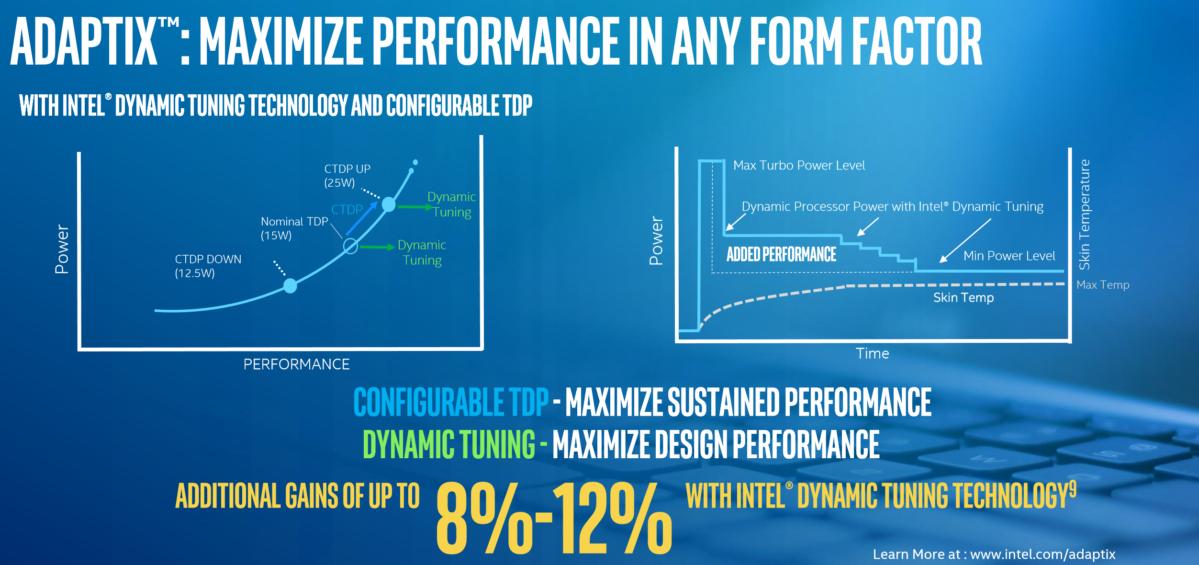
First, Intel's Comet Lake chips will support Intel's Adaptix technology, which taps intrinsic laptop and CPU sensors, knowledge of the available world power, and the PC maker's own preferences. Adaptix deeds in the middle prime between the maximum turbo power level and the available CPU power, hard to sustain an increased level of performance if the conditions let for it. The advantage here is that you'll see less of a choppy up-down on/off switch between turbo manner and a more rule clock speed, and a longer period of cleared operation for prolonged workloads.
 Intel
Intel Here's a somewhat disorienting seeable representation of how Intel characterizes Adaptix. If you recollect of Adaptix As "some additive public presentation, sustained over time," you'll have a better understanding of what Adaptix means.
Second, Intel also ships each mobile CPU with some wriggle room for notebook computer makers, allowing them to trade bump off higher power use of goods and services (and probably lower battery life) for more upclocked carrying into action. Intel refers to this American Samoa the "nominal TDP" and the "Config Raised TDP."
ICE Lake's notebook chips use a specified TDP of 15W and a "Config Dormie" TDP of 25W; the tablet processors scale from a nominal TDP of 9W to 12W. Comet Lake's U-series notebook processors also ware 15W nominally, and 25W in the "UP" configuration.
In the Y-series tablet space, though, the differences are stark. While Ice Lake consumes 9W to 12W, conditional the configuration, a Comet Lake's Y-series chips offers the option of as low as 4.5W, 7W nominal TDP, and 9W UP. (The three TDP tiers—a "down" or downclocked tier, a nominal level, and the "UP" grade are fairly typical; for equivalence's rice beer, Whiskey Lake's Y-series chips consumed 3.5W down, 5W tokenish, and 7W UP.)
Intel says that Comet Lake's lower power is a factor of integration—Ice Lake integrates more functionality (including a GPU), so it consumes more power, Senderowitz aforesaid. In total, Intel's claiming that Comet Lake-supercharged devices can achieve up to 16 hours of telecasting playback time.
Merely Comet Lake's overall power consumption maxes out where Ice Lake begins. The implication is pure: spell in that location aren't many Windows tablets in the market, PC makers wish need to consider Comet Lake for low-power tablets, as well as Whisky Lake.
What's quicker: Comet Lake, Ice Lake or Whiskey Lake?
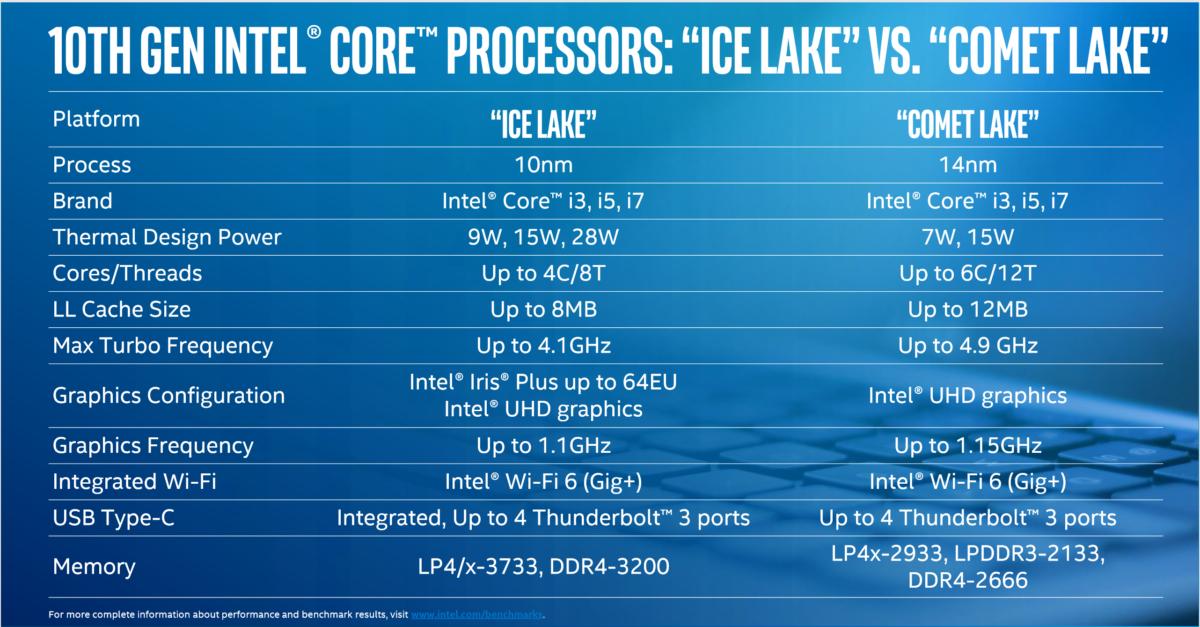
We still have at the best a vague video of how Comet Lake, Ice Lake, and Whiskey Lake will progress relative to i another. We know how Intel believes the 10th-gen Comet Lake chips compare to Whisky Lake: a 16 percent overall improvement, plus a 41 percent improvement in Office 365). Intel besides provided a summary of the specifications of some the Ice Lake and Comet Lake chips.
 Intel
Intel Intel's Glass Lake versus Comet Lake. Specifications supplied aside Intel.
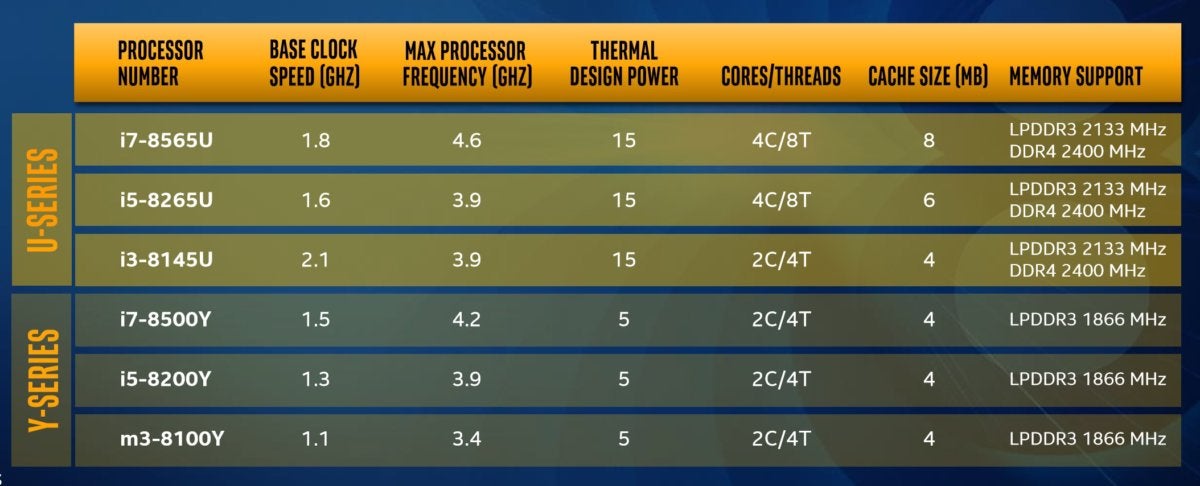
Our performance preview comparing Ice Lake to Whiskey Lake as wel provides to a greater extent detail on how Intel's rival 10th-gen part will compete with the 8th-gen Whiskey Lake. Here's the Whiskey Lake launch lineup, along with a reassessmen of the powerful Whisky Lake-battery-powered Dell Latitude 7400 2-in-1:
 Intel
Intel Our preliminary execution report demonstrated some narrow carrying into action improvements (a 15-watt Ice Lake U scored about 8 per centum higher than Whisky Lake in Cinebench R15, for example) with book of instructions-per-clock improvements being commencement somewhat by slower clock speeds.
In graphics, however, Ice Lake's Iris diaphragm Plus artwork punished the remote slower Whiskey Lake. We've also explored why Ice Lake's report clock speeds aren't necessarily cause for alarm. We North Korean won't know to a greater extent until we receive actualized shipping notebooks to test.
The other doubtfulness, naturally, is how Internal-combustion engine Lake will compare to Comet Lake. We don't know the answer to it either, though we'd suspect that the single-threaded applications will benefit more from the Comet Lake's higher clock speed, while multi-rib applications will obviously take advantage of the Core i7-10710U's higher core and thread counts. Below is Intel's Frosting Lake launch card, for comparison's rice beer. (We don't have any Ice Lake-battery-powered notebooks for review yet.)
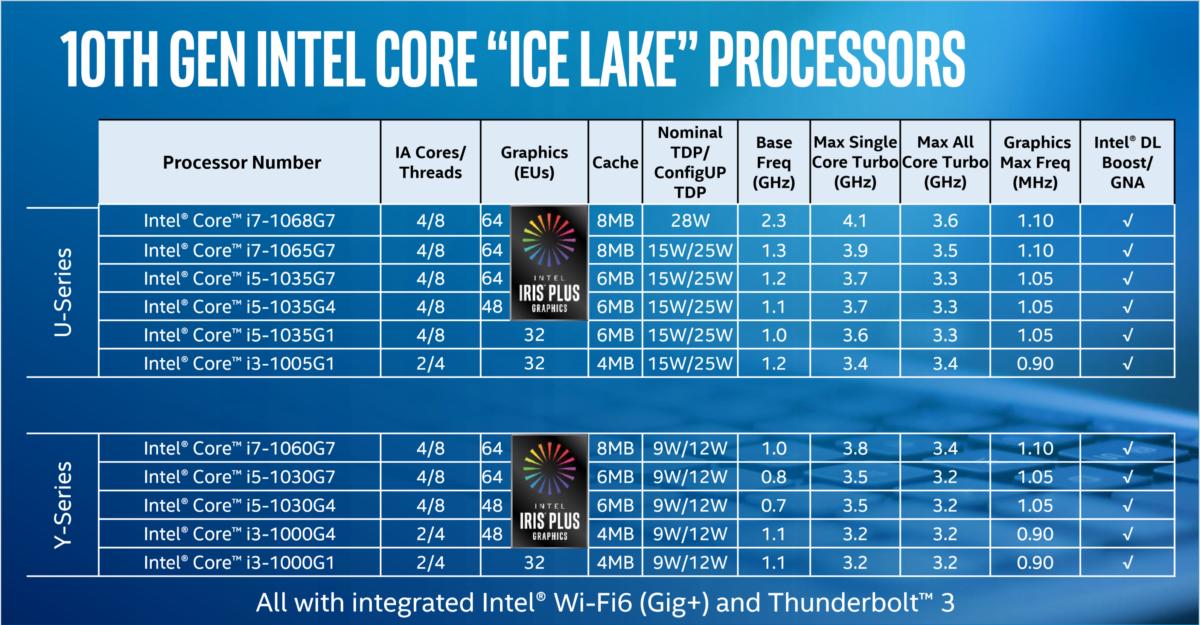 Intel
Intel The last question we asked of the PC makers themselves: Which types of laptops will include which processors, for products shipping this vacation season? We asked Acer, Dell, HP, and Lenovo to clarify the consequence. None were voluntary to go along the record, and complete were uneager to speak.
On Wednesday, however, Dell declared that its XPS 13 was existence refreshed with the Comet Lake chip, with a base price of $899, and various of its Inspiron consumer PCs, such as the Inspiron 14 5000, are also receiving Comet Lake. That's a strong tell that Comet Lake wish be a mainstream chip, and that Ice Lake (being used in the XPS 2-in-1) will be reserved for bounty machines.
IT's probably safe to say, as recovered, that totally concern notebooks will eventually address Coffee Lake once the vPro options begin transportation next year. So far, we've seen Ice Lake set-aside for premium notebooks, possibly because of 10nm supply issues. After that? It's mostly an open question.
The implications are clear, though: For the first time in quite a while, you're going to make up spoiled for quality when IT comes to notebook computer purchases during the holiday season of 2019. Will PC makers, and thus customers, settle on just one processor? Or testament all be live? We'll do our best to help you resolve which notebook Personal computer central processor is right for you once we can pay off our hands on few transport hardware.
This story was updated at 10:08 AM with additional details from Dell.

Source: https://www.pcworld.com/article/397893/intel-announces-comet-lake-a-faster-10th-gen-whiskey-lake-chip-for-mainstream-laptops.html
Posted by: purvistwoulair.blogspot.com
0 Response to "Intel announces Comet Lake, a faster, 10th-gen Whiskey Lake chip for mainstream laptops - purvistwoulair"
Post a Comment